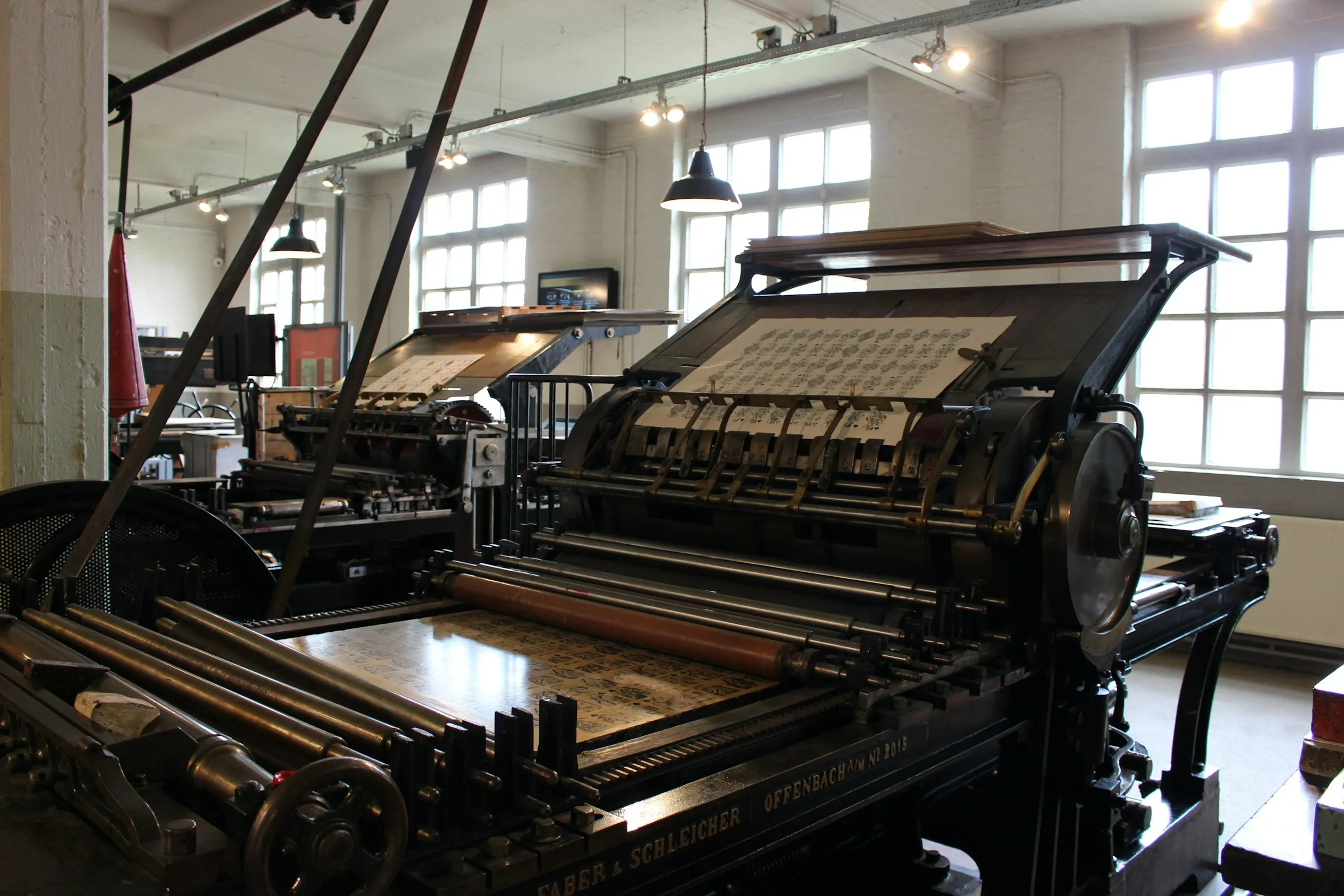
Pulling a proof in my basement printshop is a magical moment. I have done it thousands of times to the point where printing is muscle memory, and it never disappoints (unless it is a bad proof). The process is almost melodic: preparing the paper, inking the plate, running the press to pull a proof to examine critically to determine next steps, if any. This cycle continues until the print is either abandoned or finished. A while back, I had a profound realization. This iterative cycle of creating the plate, printing the plate, critique, and then refinement mirrors how successful AI systems are implemented and deployed. These parallels between printmaking’s technical methodology and how to successfully deploy AI have led me to believe that having a liberal arts background, particularly one versed in the studio arts, is a unique advantage in leading technological transformation in the era of AI.
Liberal arts is a feature, not a bug.
I remember the discussions with friends and family while I was attending university. A common theme of conversations when the topic of my printmaking major came up was some version of ‘Why don’t you major in something useful?’ At the time, I thought I was being a little punk rock but I believed that university was about investing in myself, challenging my understanding and generally working on two key attributes: 1. Learning how to learn and 2. Developing a habit of thinking deeply about whatever topic I was engaging with. I like to say now that liberal arts is a feature, not a bug. Stewart Butterfield, philosophy graduate and co-founder of Slack, is a great example. His education in philosophy taught him to “follow an argument all the way down,” a skill that proved invaluable to building Slack into a company that was worth $27.7 billion to Salesforce.
A surprising truth about AI
As a proud MFA graduate of Ohio University’s Print Program (Go Bobcats!), I have realized that my experiences in ‘Art School’ uniquely position me (and other art graduates) to excel at supporting AI initiatives and implementations. Graduate studies in art and printmaking specifically foster a set of skills and practices that complement project delivery and AI implementations, building on the general liberal arts upbringing from my undergraduate studies. Printmaking is a process. Traditionally, you make a plate, print it and then proceed to make an edition of exactly the same image. You’re judged on more than just the image you created but the fidelity of edition to itself.
LLMs are remarkable tools, excelling at pattern recognition, data processing, and context generation. Most recent releases of foundation models are impressive simulacra of human interaction, they are still tools much like a fancy hammer. Without a strong human partner applying guard rails and reframing questions, they lack nuance, effective reasoning, and creative problem-solving. This is the opportunity for us liberal arts folks to shine. We can lead the AI tools to better deliver value by applying our trained intuition and, in the case of printmaking, my love of process and predictable outcomes. AI is better as a partner than an output device.
Getting AI right has significant value.
Some recent industry research highlights the value proposition of AI with compelling ROI evidence: companies using generative AI get an average return of $3.7 for every dollar spent, while top performers achieve $10.3 for every dollar invested.1 So how does printmaking prepare us to capture this unrealized value? The answer lies in the fundamental process itself. The potential for value creation is significant and why your LinkedIn feed is full of updates of AI and LLMs.
Additionally, McKinsey’s 2025 report revealed that while many companies are reporting on their investments into AI, just 1% believe they are at maturity. Given the sheer volume at all levels of business, this low level of maturity is surprising. This finding highlights the critical need for skilled human oversight that goes beyond just the technical implementation.2 Also, Boston Consulting Group published in late 2024 that only 26% of companies had developed the necessary capabilities to promote proofs of concepts to production and generate tangible value from AI.3 There is significant unrealized value there; the World Economic Forum predicts 69 million new jobs will emerge from the transformation, with many requiring a focus on collaboration and communication skills — skills honed by a liberal arts education.
The printmaking paradigm: matrix, process, and proof
Printmaking exemplifies iterative refinement by its very nature. A plate and its corresponding print are rarely created in one shot. Proofing, where you get an impression (literally) of where the image stands and make adjustments, is a crucial part of the process. Iteration is essential to achieve anything resembling value from an AI initiative. It starts with a matrix, a metal plate, woodblock, or slab of lithographic limestone that serves as the surface from which prints are made. This is the foundation for image making and creating multiple impressions required for the edition. It is a parallel to the foundational models within the AI ecosystem. Making a print requires the artist to work through progressive states. In printmaking, ‘states’ are printed proofs that document the development of an image. Each captures the iterative changes made until the desired outcome is achieved. AI developers iterate through model versions (have you checked out Hugging Face lately?), testing, and refining.
Rembrandt worked through as many states of a single etching. Each of his states represented a refinement and snapshot of his vision. In my experience getting AI solutions implemented, the iteration process is a direct parallel. Deployments progress through multiple iterations, where each “state” represents an improvement in accuracy, bias reduction, or performance optimization.
Just as Rembrandt’s multiple etchings states led to masterworks that endure centuries later, the iterative refinement process inherent in printmaking provides a framework for AI success. In my next article, I’ll explore how printmaking techniques and practices offer practical strategies for AI teams seeking to move from proof of concept to production. Our matrix is prepared, now let’s examine how to pull the perfect print.
Footnotes
-
Hypersense Software. (2025, January 31). “2024 AI Growth: Key AI Adoption Trends & ROI Stats.” Retrieved from https://hypersense-software.com/blog/2025/01/29/key-statistics-driving-ai-adoption-in-2024/ ↩
-
McKinsey & Company. (2025, January 28). “AI in the workplace: A report for 2025.” Retrieved from https://www.mckinsey.com/capabilities/mckinsey-digital/our-insights/superagency-in-the-workplace-empowering-people-to-unlock-ais-full-potential-at-work ↩
-
Boston Consulting Group. (2024, October 24). “AI Adoption in 2024: 74% of Companies Struggle to Achieve and Scale Value.” Retrieved from https://www.bcg.com/press/24october2024-ai-adoption-in-2024-74-of-companies-struggle-to-achieve-and-scale-value ↩